- 0 views
- By Caroline McNally
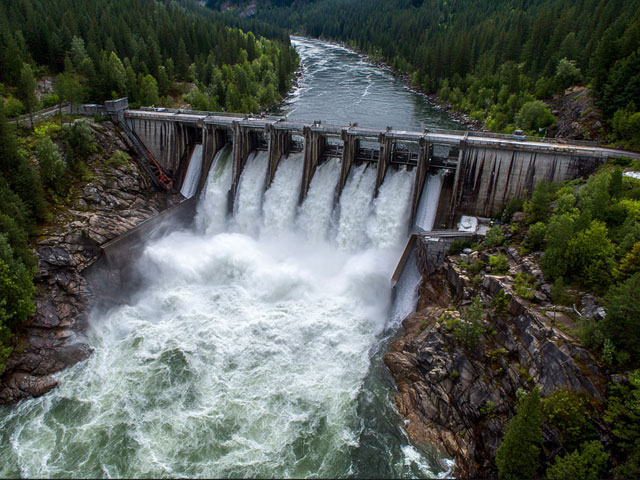
Hydropower has long been a foundational pillar of the U.S. electricity system, especially in regions blessed with steep terrain and abundant rivers. But today, it’s evolving — aided by fresh federal investment, new tools, and shifting energy demand dynamics. In this blog, we’ll survey how hydropower is being deployed, expanded, upgraded, or repurposed in different states, trends and challenges to watch, and a few emerging success stories.
A National Context: Why Hydropower Still Matters
Hydropower remains one of the few truly dispatchable renewable power sources — meaning utilities can ramp it up or down to balance supply and demand, provide grid stability, and support clean energy goals. Although hydropower accounts for a modest share of U.S. capacity (under 7 % in many recent years), it punches above its weight in flexibility and stability.
Hydropower generation is sensitive to precipitation and river flows. In 2024, the U.S. experienced one of its lowest hydropower outputs in recent memory, largely due to droughts in the western states. Projections for 2025 suggest a modest rebound, though still below the decade average.
Many existing hydropower plants are approaching relicensing under the Federal Energy Regulatory Commission. Nearly 450 stations (≈16 GW) are up for relicensing over the next decade, a process that could reshape the hydropower fleet: either stymieing aging systems or opening the door for modernization.
Meanwhile, federal stimulus and infrastructure programs are funding upgrades and modernization projects, especially for smaller dams, “non-powered dams” (dams not originally outfitted with turbines), and pumped-storage upgrades.
To help utilities and developers navigate their options, the Idaho National Laboratory has launched a Hydropower Technology Catalog: a curated, up-to-date online guide that allows users to match sites with turbine types, performance metrics, costs, and application classes (e.g. impoundment, run-of-river, conduit, hydrokinetic). In short: it reduces guesswork and accelerates decision-making in early-stage projects.
As states and utilities push toward renewable energy targets, hydropower — especially in upgraded and modular forms — is positioning itself as indispensable in the energy transition mix.
State-by-State Snapshots of Hydropower Activity
Below are representative examples of how states and regions are leveraging hydropower — including scaling up, repurposing, and innovating.
Washington (Pacific Northwest)
Washington remains the U.S. leader in hydroelectric generation. In 2024, nearly 60 % of the state’s electricity came from hydropower, and the state accounted for roughly 25 % of the nation’s hydroelectric output.
Large federal dams like Grand Coulee and Chief Joseph dominate, but regional power demands are also served by smaller systems — for instance, the Jackson Hydroelectric Project (112 MW) on the Sultan River contributes to Snohomish County’s local grid.
To maintain its edge, Washington has been modernizing older turbines, leveraging federal incentives, and integrating hydropower into regional grid balancing strategies.
Maine (New England)
Maine is redoubling efforts to expand hydropower’s footprint. Roughly half of Maine’s renewable generation comes from hydro already, though much of that is aging infrastructure.
Legislation under consideration would direct the state public utilities commission (or energy office) to study expanded hydropower and geothermal energy integration.
In addition, a pumped‐storage hydropower project (≈500 MW) was proposed in Oxford County, marking Maine’s first serious foray into energy storage via pumped hydro.
Federal funds are flowing in: Maine has received millions to upgrade hydropower infrastructure across 21 projects, as part of a broader national incentive package.
One legacy example is the Ellsworth Dam on the Union River: built over a century ago, it still contributes modest generation to the regional grid, and has had to grapple with relicensing, ecological mitigation and modernization.
Alaska (Juneau region and beyond)
Alaska — with its high rainfall, rugged terrain, and remote communities — is simultaneously one of the most promising and most challenging hydropower markets.
In Juneau, the newly organized Juneau Hydropower Inc. aims to build Sweetheart Lake (19.8 MW) and run the local utility. The project’s financing relies heavily on federal loans, state support, and investment tax credits — creating friction in regulatory approval.
Juneau already has five operating hydro plants plus two under development. In average years, hydropower output can reach ~420 GWh, closely matching current consumption while leaving room for industrial growth.
Elsewhere in Alaska, ambitious ideas like the Susitna hydroelectric project (proposed 600 MW) sit in limbo, largely blocked by environmental complexities and cost escalations.
Minnesota
In Minnesota, hydropower plays a more modest role, focused on run-of-river and legacy systems. Minnesota Power runs 11 hydroelectric plants across the state’s rivers (primarily in central and northeast Minnesota) under multiple FERC licenses.
One smaller‐scale example is the St. Cloud Dam on the Mississippi River, retrofitted to produce ~8.5 MW of electricity now fed into the regional grid.
Minnesota also observes stringent licensing durations (30–50 years) and operational requirements for flow management and environmental impact.
Colorado (Emerging / Small Hydro)
Though not a hydropower powerhouse, Colorado has seen recent deployment of small hydro projects. For example, the Taylor River hydro plant (~500 kW) is expected to produce ~3.8 GWh annually, showing how under-utilized streams and mountain runs can be tapped cost-effectively at small scale.
Small hydro and low-head systems — using irrigation canals, municipal water systems, or existing dam structures — are gathering interest nationwide because they often come with lower permitting burdens and environmental impacts.
Trends, Challenges, and the Road Ahead
- Modernization over Greenfield
The biggest near-term gains in U.S. hydropower will likely come from upgrading and optimizing existing plants rather than building massive new dams. Many existing dams lack turbines (non-powered dams), or run with legacy equipment that can be retrofitted with higher-efficiency turbines.
The INL technology catalog plays right into this trend by helping developers explore modular, site‐appropriate turbine options.
- Pumped Storage and Energy Storage Integration
Pumped-storage hydro remains the dominant form of grid-scale storage in the U.S. and is a powerful complement to intermittent solar and wind. Many states are exploring pumped-storage as a way to add hours-long reliability.
The Maine proposal above is a signal that even in regions not historically known for pumped hydro, the model is being considered.
- Financial & Regulatory Barriers
Capex, permitting, relicensing timelines, and risk of financing remain major hurdles. Hydropower often demands long-term capital outlays with payback periods in decades — which can dissuade private investment without supportive policies.
In Juneau’s case, regulators worried about the developer securing funding before a certificate was granted, creating a chicken-egg financing dilemma.
Relicensing under FERC is another pain point: developers must meet evolving environmental standards, fish passage requirements, and often negotiate local stakeholder buy-ins.
- Variability and Climate Risk
As hydropower depends on rainfall, snowmelt, and river flows, shifts in climate and precipitation patterns pose a real risk. Many plants have seen declining capacity factors over decades.
Strategic site selection (with hydrological data), adaptive operations, and blended portfolios (combining hydro with solar, wind, storage) are becoming essential.
- Digitalization & Advanced Monitoring
Hydropower operations are getting smarter. Recent research is exploring sensor-driven prognostic maintenance frameworks — letting operators schedule maintenance proactively rather than by fixed intervals.
Modeling tools are emerging to fill gaps in hydropower-grid integration, capturing complexities of water availability, multi-unit interdependencies, and dispatch constraints when co-optimized with other renewables.
Final Thoughts
Across Washington, Maine, Alaska, Minnesota, Colorado, and beyond, hydropower continues to be reimagined — not as a relic of early electrification, but as a resilient, valuable piece of a modern, decarbonized grid.
In the West and Pacific Northwest, hydropower still anchors clean power systems. In the Northeast and Atlantic region, expansion and pumped-storage experimentation are emerging. In remote parts of Alaska, hydropower offers the promise of replacing diesel and improving energy independence. At smaller scales, run-of-river and modular projects are being deployed in places previously considered uneconomical.
The future of hydropower in the U.S. is less about massive new dams and more about intelligent modernization, integration with storage and digital controls, and strategic deployment in complementary roles. The next decade’s hydropower renaissance will be one of nuance, adaptation, and bridging old infrastructure with new technologies.
Conclusion
Floods and severe weather test the resilience of utility poles—and the communities that rely on them. The damage extends far beyond disruption, striking at public safety, emergency response, and daily life. But through smart maintenance, upgraded materials, and strategic planning, utilities can reduce risks and accelerate restoration. As climate threats intensify, resilience isn’t optional—it’s essential.


Related articles and news
 Utility Workers
 Powering the Future: Scholarships and Career Paths in the Energy Sector
The energy sector is undergoing one of the most dynamic transformations in decades. As regions like New York and Massachusetts push toward cleaner, mo …
Read more Utilities Technology
 Utilities Tech to Watch in 2026: How 3D Intelligence and Advanced Analytics Are Re-Shaping the Grid
The utilities industry is heading into 2026 with a rare combination of pressure and opportunity. Rising electricity demand from electrified transporta …
Read more